
Quick answer: match the container to how often the paper moves. Records that get filed and left alone belong in the SentrySafe SFW123GDC, which pairs a UL Classified 1-hour fire rating with an independently verified water seal. Offices that pull folders daily should spend up for the FireKing Turtle Vertical 2-Drawer instead, because a cabinet gets closed and a chest gets left open. The SentrySafe Doc Box covers the narrower job of a grab-and-go set of originals.
What an Office Actually Has to Keep Readable
Start by sorting the office paperwork into three piles, because they need different containers. The first pile is documents that are painful but possible to reissue: bank statements, prior-year returns your accountant also holds, supplier invoices. The second is originals that are slow or expensive to replace: incorporation and partnership paperwork, deeds and leases, signed client contracts, insurance policies, titles, licenses and permits. The third is digital media: backup drives, USB keys, the SSD out of the old workstation.
That third pile is where a fire rating gets misread. A UL Class 350 rating, the one almost every office safe and fire-rated cabinet carries, certifies that the interior stayed under 350 degrees Fahrenheit during the test. Paper needs that because it chars somewhere around 400 to 450 degrees. Magnetic and solid-state media do not survive anywhere near 350 degrees, which is why media protection is a separate Class 125 rating. Buying one Class 350 box and putting the backup drive in it is the most common planning error in a small office; the fireproof storage options for hard drives and SSDs cover what the media pile actually needs.
The second factor is water. Fire suppression is water, whether it arrives from a sprinkler head or a hose line, and a container can come through the heat intact and still leave you with pulp. Treat an independently stated water rating as a requirement rather than a bonus feature. The third factor is the one nobody puts on a spec sheet: how many times a day someone has to open the thing. A chest-style safe that is awkward to reach into gets propped open by lunchtime, and an open safe has no rating at all.
Three Setups That Cover Most Small Offices
SentrySafe SFW123GDC
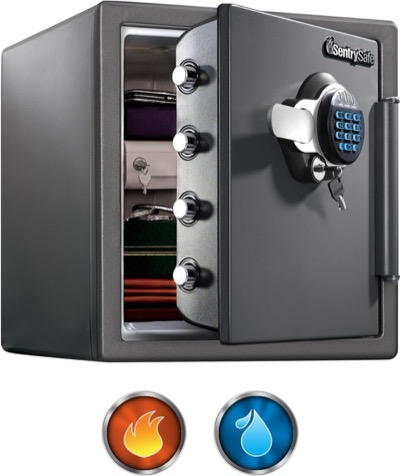
UL Classified for 1 hour of fire protection and ETL verified against water submersion at 8 inches for 24 hours, with a digital keypad plus an override key. The most protection per dollar for records that stay filed.
Check price on Amazon →FireKing Turtle Vertical 2-Drawer
A UL Class 350 1-hour cabinet that holds hanging letter and legal folders in two drawers, with a key lock. Premium tier and several hundred pounds, but it is the only format here that fits a working filing workflow instead of fighting it.
Check price on Amazon →SentrySafe Doc Box
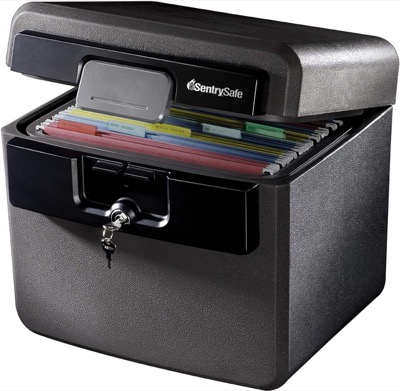
UL rated for 30 minutes of fire protection with a water rating and a key lock, in a box light enough to carry out by the handle. Budget tier. Right for a home office or a satellite location that only holds a core document set.
View on Amazon →Ratings, Seals and Locks Side by Side
Certification columns below reflect what each manufacturer documents for that specific model. Where a rating is manufacturer-claimed rather than third-party listed, the table says so, because the two are not interchangeable.
| Unit | Brand | Fire rating | Water protection | Lock | Best for | Price | Link |
|---|---|---|---|---|---|---|---|
| SentrySafe SFW123GDC | SentrySafe | UL Classified, 1 hour | ETL verified, 8 in / 24 h | Digital keypad + key | Filed records | $$$ | View |
| FireKing Turtle Vertical 2-Drawer | FireKing | UL Class 350, 1 hour | Check listing | Key lock | Daily filing | $$$$ | View |
| SentrySafe Doc Box | SentrySafe | UL rated, 30 minutes | Water rated | Key lock | Grab-and-go originals | $$ | View |
| ENGPOW Accordion File Organizer | ENGPOW | Manufacturer-claimed resistant, not UL listed | Manufacturer-claimed resistant | None (zip closure) | Sorting inside a safe | $ | View |
Price tiers are approximate. $ = under $50, $$ = $50 to 150, $$$ = $150 to 300, $$$$ = over $300. Tap any link for the current Amazon price.
Chest, Box or Fire-Rated Cabinet
The format question comes before the brand question. A box-style fire safe such as the SentrySafe SFW123GDC gives roughly the cheapest protected cubic foot available with a real third-party listing on both fire and water, and SentrySafe documents the model's ratings on its own SFW123GDC product page. The trade-off is retrieval: contents stack rather than hang, so finding one folder means lifting the ones above it. That is fine for prior-year returns and closed contracts and poor for an active client file. Check price on Amazon.
The FireKing Turtle Vertical 2-Drawer answers the retrieval problem and charges for it. Fire-rated cabinets are built as an insulated shell around drawer bodies, which is why they land in the premium tier and weigh several hundred pounds empty. FireKing publishes the construction and rating details for the line on its Turtle series product page. Two practical notes for an office: confirm the floor loading and the route to the room before ordering, because these do not go up a narrow stair easily, and plan for drawer clearance in front of the cabinet. The wider field of fire-rated cabinets is covered in the fireproof file cabinet comparison. Check price on Amazon.
The SentrySafe Doc Box is the narrow-purpose pick. A 30-minute rating is half the exposure window of the SFW123GDC, so it suits a defined set of originals rather than the whole filing system, and the carry handle is the point: it leaves the building with you. Several small offices use one inside a larger safe so the critical set can be pulled in one motion. View on Amazon.
The ENGPOW Accordion File Organizer is not a safe and should not be bought as one. Its fire and water resistance is manufacturer-claimed, with no third-party listing, so its job here is organizing the contents of a real safe into labelled sections so the drawer-less format stops being a pile. Budget tier. View on Amazon.
Reading a Fire Rating Without Overestimating It
A fire rating is the result of a furnace test, not a promise about your building. UL 72 is the standard behind the listings used in this category; the scope is published by UL Standards for record protection equipment, and the class number refers to the interior temperature held, while the time refers to the rated exposure. Two consequences matter for an office. First, a one-hour unit is not a two-hour unit held longer; past the rated window the interior climbs quickly. Second, a listing from UL or an ETL verification by Intertek means a third party ran the test, which is a different claim from a manufacturer-stated resistance. Intertek explains the ETL mark and what verification covers if you want to see where the line sits.
Placement does more work than most buyers expect. Fire-rated containers are tested on a furnace floor, not dropped two storeys into a basement, so a ground-floor interior room away from the fuel load of a kitchen or electrical panel is worth more than one extra rating tier. If the office keeps cash as well as paperwork, the fire rating does nothing for theft resistance, and that trade-off is laid out in the burglary-rated safe comparison.
What Office Owners Report After a Year
Themes paraphrased from verified-purchase Amazon reviews and from small-business and preparedness discussion threads (/r/smallbusiness, /r/preppers, /r/personalfinance, /r/homedefense) as of October 2026. Safe Picked aggregates reported patterns and does not own or test these units.
- Humidity inside a sealed fire safe is the most common complaint. The insulation in a fire-rated body holds moisture, and owners who keep documents sealed in a water-rated safe in a humid climate report musty paper and curling edges within a year. The fix owners settle on is a rechargeable desiccant canister swapped on a schedule, and leaving the door open for an hour when the office is occupied.
- Keypad models get locked out by dead batteries more often than they fail outright. Owners who keep the override key in a desk drawer in the same room report no real problem; the ones who had it sealed inside the safe report a locksmith visit. Keep the key off site or in a separate container.
- Capacity is routinely underestimated. A nominal cubic-foot figure shrinks fast once insulation thickness and a lid-side tray are accounted for, and reviewers consistently describe filling a box-style safe faster than expected. Buying one size up is the most repeated piece of advice in this category.
- Delivery and placement cause more grief than the product. Fire-rated cabinets arrive on a pallet and need a liftgate and a path with clearance. Several reviewers describe curbside drops they could not move, which is worth settling with the seller before the order rather than after.
- Media stored in a paper-rated box is a recurring regret. Owners who treated a Class 350 unit as a drive safe only learn the distinction when they go looking for the rating. This is the error most worth catching before the purchase rather than after.
Jacob’s read on this category
Office fire storage is the one safe category where the workflow beats the certificate. A one-hour UL listing on a box that nobody wants to open ends up protecting an empty interior, because the folders live in a tray on top of it instead. Before comparing ratings, count how many times a week someone has to touch the records: anything above a handful points at a fire-rated cabinet even though it costs several times more, and anything below it makes the box-style safe the obvious answer. The second thing I would settle early is the digital pile. A Class 350 listing is a paper rating, and a business that keeps its only backup drive in a paper-rated safe has a single point of failure it has already paid to protect badly. An encrypted off-site copy costs less than upgrading the safe.
Questions Small-Business Buyers Ask
What does a UL Class 350 one-hour rating protect in an office?
It means the interior stayed below 350 degrees Fahrenheit for the rated hour during the furnace test. Paper chars at roughly 400 to 450 degrees, so Class 350 is a paper-and-file rating: tax records, contracts, deeds, leases, incorporation paperwork, insurance policies. It is not a media rating. Drives, USB keys and tape need a Class 125 interior, so a mixed office either buys a Class 125 unit or keeps a separate media container inside the Class 350 safe.
Is a one-hour fire rating long enough for a commercial building?
For most small offices it is a reasonable floor, but the rating describes a test, not your building. How long the fire burns before it is knocked down and where the unit sits both matter. A ground-floor spot near an exterior wall sees a shorter, cooler exposure than an interior storeroom under a collapsing roof, and a unit that falls through a floor can break open on impact, so placement is worth more than an extra rating tier.
Should a small business buy a fire safe or a fire-rated file cabinet?
It depends on how often the records are touched. A box-style safe is cheaper per cubic foot and better for records filed once and rarely reopened. A fire-rated cabinet costs considerably more and weighs several hundred pounds, but it holds hanging letter and legal folders in a form staff will actually use daily. Offices that move paper every day tend to leave a box-style safe open, which defeats the rating entirely.
Do fire-rated safes also protect against water from sprinklers and hoses?
Not automatically, and this is the failure that surprises owners most. Suppression means water, and a fire-rated container with no water seal can come through the heat intact and still leave pulp. Look for a water rating stated separately from the fire rating, such as an ETL verification for submersion at a stated depth and duration. A sealed plastic sleeve around anything irreplaceable is a cheap second layer, and the wider fireproof document safe lineup flags which models carry both ratings.
Does a fire safe satisfy record-retention obligations for a business?
A safe protects documents but satisfies no retention rule by itself. Retention periods for tax, payroll and employment records are set by federal and state agencies and by industry regulators, and several run for years after the record is created. Keep originals that are hard to reissue in the fire-rated unit, keep an off-site or encrypted cloud copy of the rest, and confirm current periods with your accountant. This is general information, not legal advice; verify current requirements before relying on them.
Screening Rules Behind This Shortlist
Every unit here was screened on documented certification first: a third-party fire listing with its class and duration stated, a separately stated water rating where the manufacturer claims one, and a lock type confirmed against the listing. Where a product carries only a manufacturer claim, the table says so rather than borrowing the credibility of a UL listing.
Beyond certification, picks are scored on retrieval format (does the office workflow survive it), capacity honesty, and a 4.2-star verified-buyer floor for new picks. Listings are swept weekly for dead ASINs and price-tier drift. Star averages quoted here come from the most recent verified pass; where a rating is not current, this page omits it rather than estimating.
If you spot a discontinued product or a rating that no longer matches the manufacturer's documentation, let us know and it gets corrected and logged.